

Yesterday, our little family of three came in from our evening walk through the squeaky back door with the ancient brassy old doorknob that always seems one extra-vigorous shake away from a serious repair job. We removed our shoes, laid them on the square blue rug, and locked up for the night to begin our nine month old daughter’s bedtime routine.
But as she sat on my right hip, our Anne looked directly at my husband Ben, tilted her head to watch him… and she began the most precious Queen-of-England- type wave with her right hand. [She’s nine months old. This is a new thing!!!]
We’ve been doing some little ‘baby signs’ with her, connecting our words with simple actions (hi, eat, drink water, milk, sleep, etc). While we’ve known for a couple months that she can understand what we say or ask by her glances or babbles, this wave was new. It served as her first way of reflecting our motions in a way that made sense to her – communicating back what we have been ‘telling her’ in signs for the last few months.
In that moment, she said and reached out in her own tiny way “Hi Papa, I see you. You see me? Hi!” Ben’s gentle smile reflected delight in seeing her new wave, and he waved back, which brought her joy to the point of giddiness. And her total gladness in communicating in a new way, and her awareness that Ben saw what she was doing — and loved her as she did it– caused me to pause.
Her new ability helped me reflect on a mother’s love for her child and gave me an almost painfully glad gratitude at seeing her grow. Both she and we are enthralled whenever she attempts to communicate with us in the way she now knows. It brought a joy that I am struggling to describe – a very “the Grinch’s heart grew three sizes that day” kind of moment as a parent.
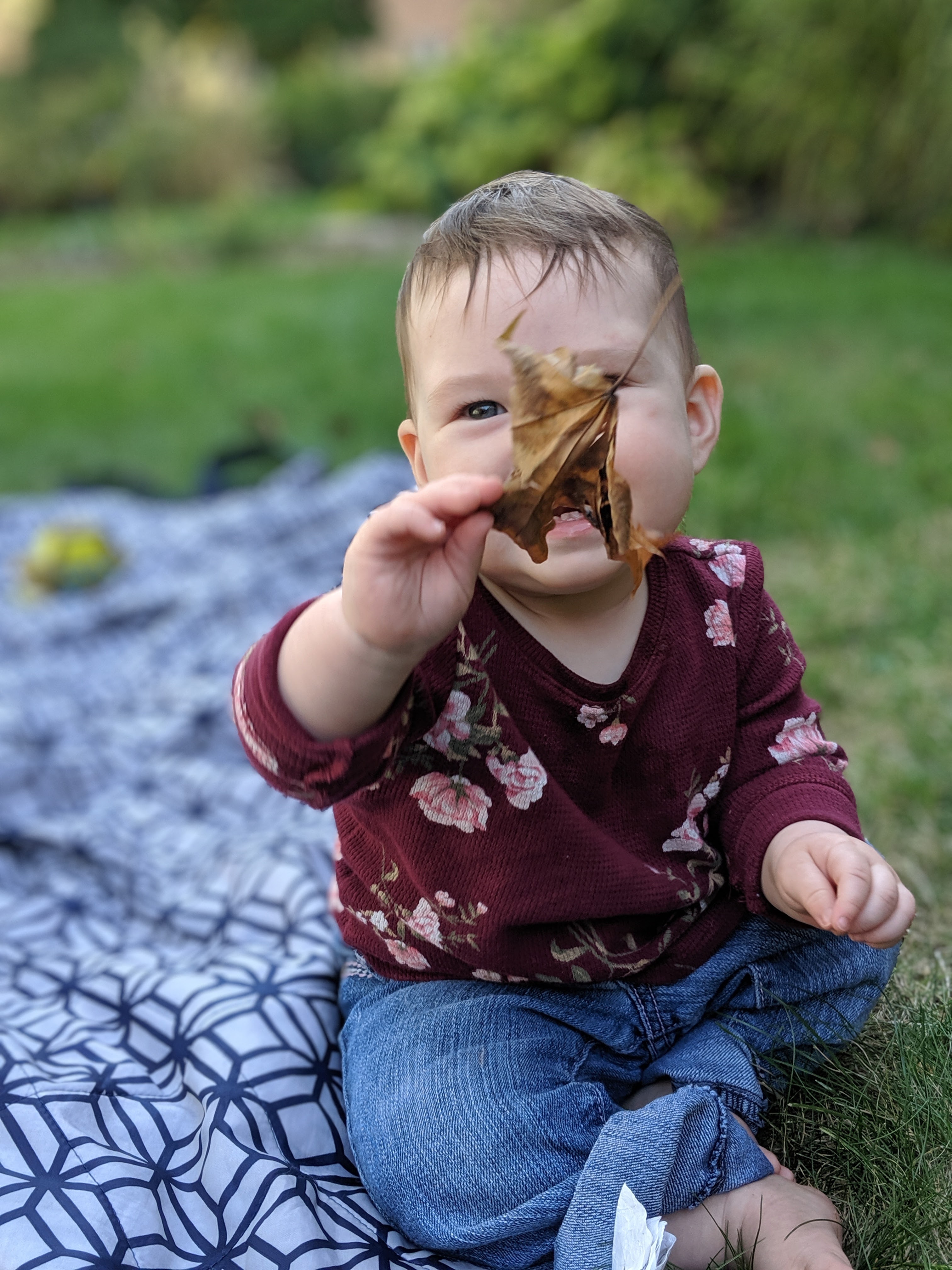
She is still learning to connect the meaning of the greeting with her physical ability to do it, so the sign gets used everywhere at the moment. In her high chair, tired of having blueberries and bell peppers? A frantic, fast, “hi hi hi hi hi hi hi GET ME OUT OF HERE, PLZ!” hand gesture. Waking up from a nap? A smile and the wave. You had the audacity to interrupt her playing for a verboten diaper change? You’ll get a betrayed look and a fast wave. The trees start swaying in the fall breeze, or a neighbor crosses the street with her tiny dog? A slow wave and a grin.
St. Therese of the Child Jesus and her writings help me to reflect on this moment of our life with our daughter. St. Therese seems to be one of those saints who keeps tabs on me non-invasively, ready to spend time when I remember she’s there. (Her parents Louis and Zélie are some of our favorite family patrons and I’ve been meaning to read this book with their writings for a couple years now).
Therese and the Hobbits (obviously!)
I first read St. Therese’s autobiography, The Story of a Soul towards the end of high school. At the time I didn’t understand her; her writing struck me as extraordinarily sappy. Her concerns over her (super small and yet dramatic???) faults brought out in me a scrupulous tendency which was often… not helpful for someone prone to anxiety. Still, her reflections sketched out some powerful images that nestled their way into my brain and my developing spirituality. To a younger and less-experienced me Therese signified an appreciation of the good of “being small” in the world’s eyes (both physically, as the shortest-kid-in-the-class/ and in a more symbolic “a small fish in a big pond” type of way).
I found comfort in passages like this:
“You make me think of a little child that is learning to stand but does not yet know how to walk. In his desire to reach the top of the stairs to find his mother, he lifts his little foot to climb the first stair. It is all in vain, and at each renewed effort he falls. Well, be this little child: through the practice of all the virtues, always lift your little foot to mount the staircase of holiness, but do not imagine that you will be able to go up even the first step! No, but the good God does not demand more from you than good will. From the top of the stairs, He looks at you with love. Soon, won over by your useless efforts, He will come down Himself and, taking you in His arms, He will carry you up”
St. Therese of Lisieux, Story of a Soul (my emphasis)
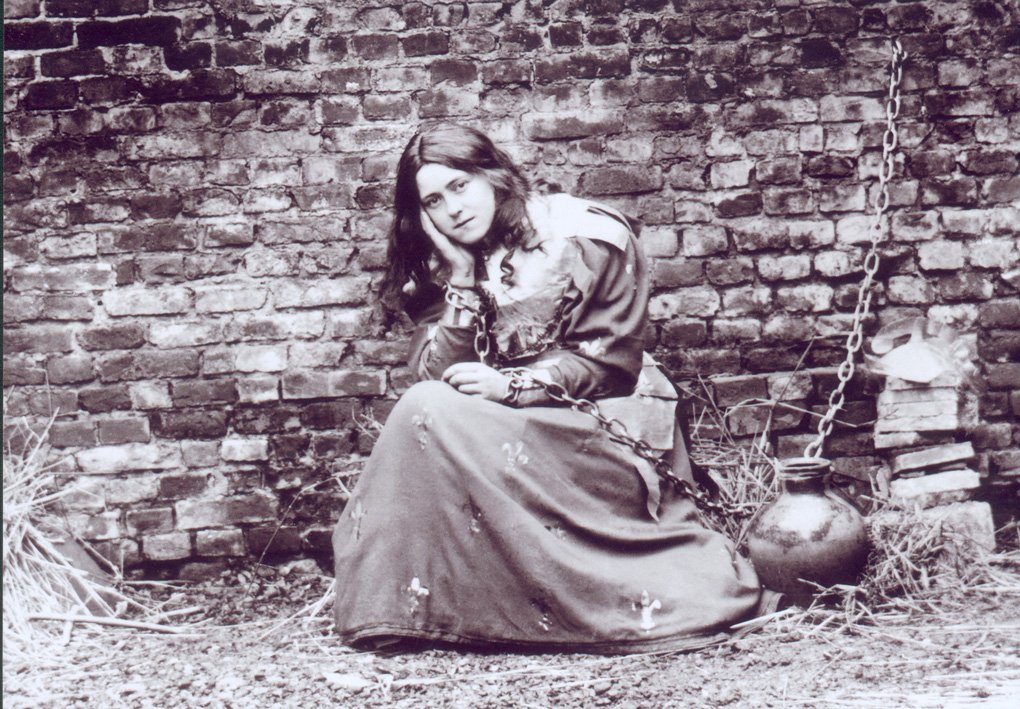
At the time, I took this excerpt and others like it to mean something like, “I’m OK as I am, even if I’m little and a mess and I can’t do much of anything…. God still loves me!” While that is true, it isn’t an adequate understanding of her words because it fails to take into account the laudable (albeit appropriately small) striving towards growth and virtue that Therese emphasized God would see and respond to with a parental, joyful love. Inspired by St. Therese and imagining a link between her and the hobbits in J.R.R. Tolkien’s world, I later learned through the writing of my senior thesis in college that neither Therese nor Tolkien loved the small merely for being small. Therese called for “the practice of all the virtues” and “lift[ing] your little foot,” reaching out to God insofar as one can. Tolkien’s discusses in many of his letters the theme of”ennoblement” or sanctification of the “the humble” — aka the hobbits — explicitly emphasizing the growth of Frodo, Sam, Merry, and Pippin in particular, not just a generic “small hobbits are cute and wonderful as they are” vibe. This emphasis of the work is manifest in a poignant scene where a dismayed Frodo asked why the Ring came to him. Gandalf responds to Frodo’s entreaties,
“Such questions cannot be answered. You may be sure that it was not for any merit that others do not possess: not for power or wisdom, at any rate. But you have been chosen, and you must therefore use such strength and heart and wits as you have”
Between Therese and Tolkien, I learned that I don’t get a free pass in the spiritual life because I’m not sure what God wants to do with lil’ ol’ me. There is virtue [teacher voice: ‘a habitual disposition to do the good’] to be developed here. The lifting of my proverbial foot, the actual striving and actively choosing to love when it is difficult—- the picking up my ‘spiritual hand’ to wave to Him, persevering in prayer even when it doesn’t bring delight or peace that I can sense—matters…. And when I do it, God delights in seeing my tiny signs of growth, as Ben and I delight in our daughter’s new waves, because I’m responding to God’s grace with the abilities I do have.
Perfection consists in doing God’s will… in being what He would have us be.
Yuppers, that’s Therese again.
God sees our striving, anywhere we respond to His grace and turn more towards him. And He will keep smiling at our small efforts, until we find that desiring and doing the good eventually becomes an effortless joy.
“So it may be said that the chief purpose of life, for any one of us, is to increase according to our capacity our knowledge of God by all the means we have, and to be moved by it to praise and thanks. To do as we say in [the Gloria]…. We praise you, we call you holy, we worship you, we proclaim your glory, we thank you….”
Carpenter (ed.) The Letters of J.R.R. Tolkien, p. 399-400
My daughter’s efforts at communication, her unbridled joy at her tiny attempts, and my total delight at her efforts remind me: the Father loves me, delights in me, and wants me to actively communicate with him however I can. He loves it when I do so. I needed the reminder through her that the Father responds in joy to me whenever I reach out to Him in love, in the ways I know how, and He will rejoice in the small ways in which I grow.
He will give me the grace to do more than the equivalent of a tiny, stiff wave one day if it’s in accordance with his will. In the meantime, He will love my slow, deliberate waves, pleased that I am lifting my arms toward Him in love and praise in the best way I can.
“If only they have the will to walk, He is pleased with their stumbles” (Lewis, The Screwtape Letters).
 Our Sacrifice Of Praise